


Sound Quality (SQ) is a fundamental concept in evaluating audio reproduction systems, including car audio, home audio, and professional monitoring systems.
In general, sound quality is often assessed through technical parameters such as imaging, soundstage, and tonal balance, which describe how accurately an audio system can reproduce a recording.
However, in advanced listening practice, many experienced listeners realize that sound quality is not determined solely by technical performance. There is a deeper dimension that relates to musical emotion, musicality, and the energy perceived from a musical performance.
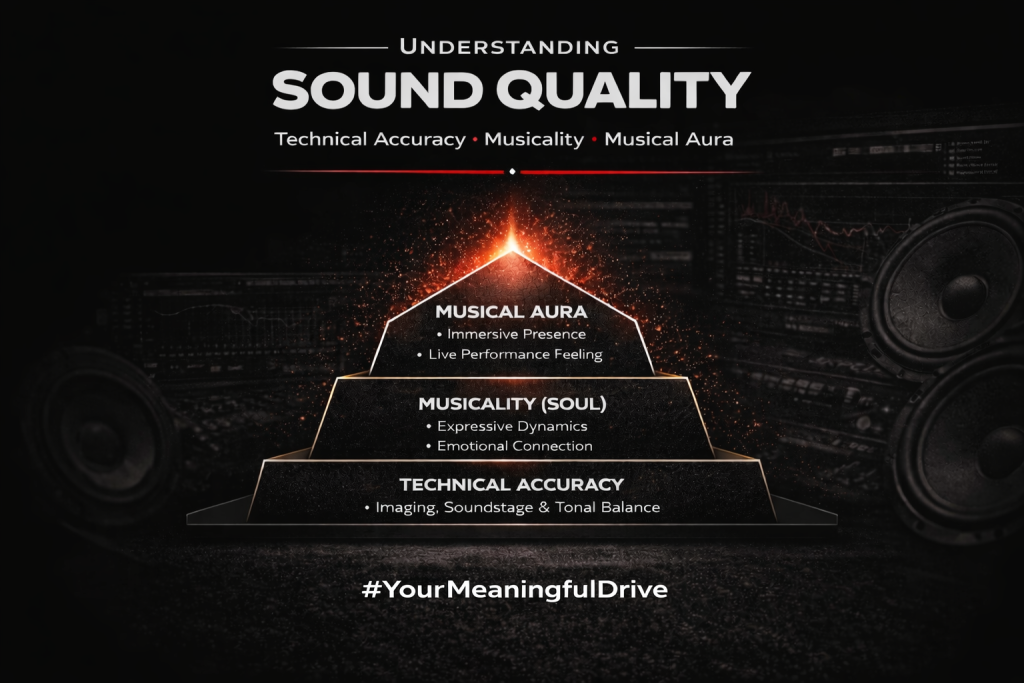
This article proposes that sound quality can be understood through three levels of listening experience:
- Technical accuracy of sound reproduction
- The presence of “soul” or musicality
- Musical aura that creates an immersive listening experience
This perspective suggests that the highest level of sound quality is not only about how accurately a system reproduces a recording, but also about how deeply the music can be felt by the listener.
1. Introduction
The primary goal of any audio system is to reproduce music as close as possible to the original performance.
In both professional audio environments and car audio competitions, sound quality is typically evaluated based on the system’s ability to reproduce recordings accurately.
Several technical parameters are commonly used in sound quality evaluation:
Imaging
The precision of instrument placement within the stereo field, allowing each sound source to occupy a a clear and stable position.
Soundstage
The spatial dimension of the sound field, including the width, height, and depth of the musical stage.
Tonal Balance
The balance of frequencies from bass to midrange to treble, ensuring that no frequency range becomes overly dominant or recessed.
These parameters form an essential foundation for evaluating audio systems.
However, in advanced listening practice, experienced listeners often discover that technically correct sound does not necessarily feel musically alive.
There is something beyond measurement—something difficult to quantify with instruments, yet clearly perceived by the ears and emotions of the listener.
2. The Three Levels of Sound Quality
Through extensive listening experience and the process of tuning audio systems, sound quality can be understood as a journey toward deeper musical experience.
This journey can be divided into three primary levels.
2.1 First Level: Technical Accuracy of Sound
The first level of sound quality focuses on technical correctness in sound reproduction.
At this stage, the audio system is capable of reproducing the information contained in the recording accurately.
Key characteristics include:
Precise Imaging
Each instrument has a clear and stable position within the soundstage.
Realistic Soundstage
The system convincingly presents the spatial dimensions of the recording, allowing listeners to perceive the width, height, and depth of the musical stage.
Balanced Tonal Spectrum
Bass, midrange, and treble are reproduced in natural proportion without any frequency range dominating the presentation.
At this level, the audio system can be considered technically correct. Listeners can understand the structure of the recording and identify the position of each instrument.
However, the listening experience remains primarily analytical rather than emotional.
2.2 Second Level: Sound with “Soul”
Once an audio system achieves strong technical accuracy, the next stage is the emergence of musicality, often described as the presence of “soul.”
At this level, music no longer just sounds correct—it begins to feel alive.
Characteristics of this stage include:
- natural musical dynamics
- realistic transient response from instruments
- more expressive and human vocal reproduction
- the emotional intention of the musicians becoming perceptible
At this stage, listeners no longer focus solely on the sound of instruments. Instead, they begin to perceive the story and emotional expression within the music.
The audio system no longer feels like a machine reproducing sound.
Instead, it becomes a medium connecting the listener with the expression of the musicians.
2.3 Third Level: Sound with “Soul” and “Aura”
The highest level of sound quality occurs when the audio system is not only accurate and musical, but also possesses musical aura.
In this context, aura refers to a perceptual experience where the audio system recreates the full presence of the musical space.
At this stage, the system is capable of:
- recreating the atmosphere of the recording environment
- making the music feel alive within the listening space
- producing a deeply immersive listening experience
Listeners are no longer simply hearing music from speakers.
Instead, the music feels as if it is unfolding directly in front of them, like a live performance taking place in the room.
At this point, the boundary between audio reproduction and real musical experience becomes extremely thin.
The listener is no longer just hearing the music.
The listener feels the music.
3. Discussion
This three-level framework suggests that sound quality involves not only technical accuracy, but also the psychological and emotional dimensions of human hearing.
This explains why two audio systems with similar technical measurements can deliver very different listening experiences.
Several factors can influence whether a system remains at the first level or progresses to deeper musical perception:
- integration between system components
- the quality of reference recordings used for evaluation
- the acoustic characteristics of the listening environment or vehicle cabin
- the precision of the tuning process
Audio systems that focus only on measurement often remain at the first level, while carefully tuned systems are capable of revealing deeper musicality and aura.
4. Conclusion
Sound quality can be understood as a spectrum of listening experiences, consisting of three primary levels:
Technical Accuracy
The system reproduces sound correctly through precise imaging, soundstage, and tonal balance.
Musicality (Soul)
The system communicates emotional expression, allowing listeners to feel the life within the music.
Musical Aura
The highest level, where music feels physically present and deeply immersive.
Ultimately, the highest goal of sound quality is not simply to make music sound clear.
The highest goal of sound quality is to make music feel alive.
